


The banned version of Tartuffe in Ivan Hove's dark and scandalous production at Anthéa, Antibes
- Nathalie Audin

- Nov 17, 2023
- 4 min read
Friday, 17 November 2023
Published on the website: Resonances Lyriques Org

© Jan Verseyweld
Naked!… Thus is the scene set in this exposed body, in the heart of the flames of hell. It is a resounding sound, coloured black and grey, with lines of shadows. A human form, almost lifeless, under a bag of coats, in a coat-like bag, emerges from its beggar's cocoon. From outstretched hands to devoted hands, the hidden devotee clings to these human grasping hands that stretch his silhouette and pull him to their home.
Slip into a steaming bath, enveloping this body straight out of Michelangelo's hand, revealing this devil in angel's clothing. In a modesty that is oh so immodest, this nude for the eyes but clothed for the mind illuminates the scene with its invisible costume, filling our thoughts with a diaphanous vapour and an intriguing mystery.
Physical, yes, he is, this Tartuffe played by Christophe Montenez, vibrating with every emotion in the flesh of his animal being. Subtle, so subtle! A half-degree turn of the head, an eyelid opened at just the right angle to embody instinctive thought, consummate cunning phrasing...
Anyone unfamiliar with the Comédie-Française's selection criteria will guess them simply by observing this member of the eminent institution, which is open only to performers of absolute perfection. Here, we don't act, we enjoy!
The impostor surrenders to the brilliant rhythm of Molière's pen, like a wild animal coveting its prey, sharpening its claws with treachery and discretion. Evil – and masculinity too – is sublime. He whips himself if necessary, using the honey of his tongue to poison those around him until they are blinded. "Poor man," repeats Orgon, the master of the house, hypnotised by the intruder, with tenderness and compassion in the exceptional voice of Denis Podalydes. Poquelin reverses roles, overturns situations, pities the wicked, condemns the good. Jean-Baptiste is afraid of nothing, but isn't he just observing the depths of the human soul as always? Thus he bluntly blurts out, between the teeth of the impostor who is pouncing on one of his prey: "I have trained him to see everything without believing anything." Mixing sincerity with lies, Tartuffe obscures the truth: "Yes, my brother, I am a wicked man, a guilty man, / An unhappy sinner, full of iniquity, / The greatest scoundrel who ever lived; / (...) Believe what you are told, arm your wrath, / And like a criminal, drive me from your house."
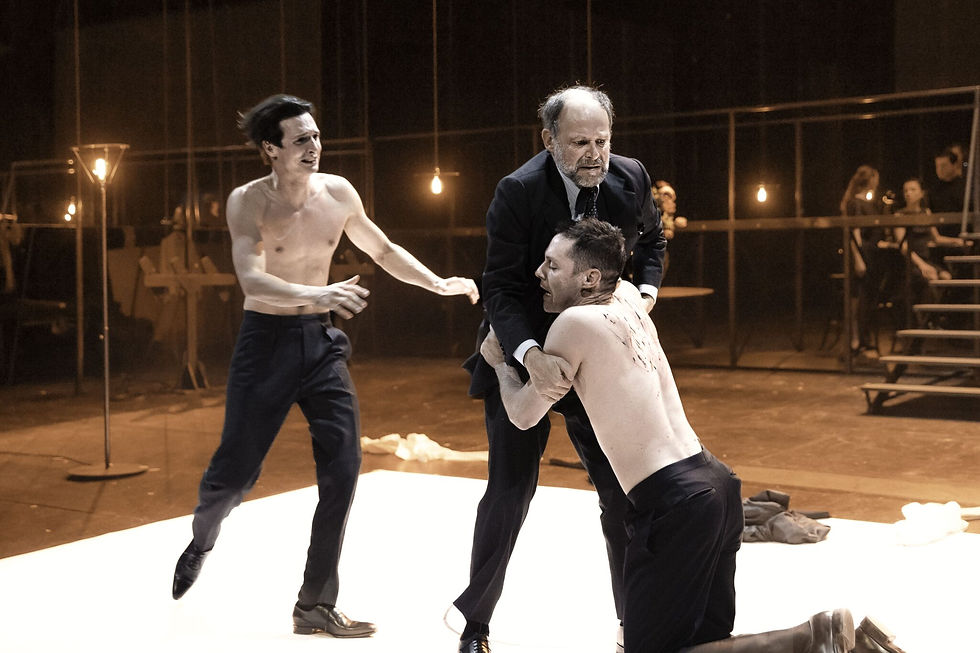
It is enough to make one lose one's mind and one's Latin when, in the end, the dice are turned and the game is reversed: Elmire, pregnant with Tartuffe's child, Orgon begging, Damis transgender, Dorine having suddenly climbed the social ladder while Cléante has dramatically fallen down it... come to greet us in these new guises, like an ironic wink from the future.
© Jan Verseyweld
Thus, on the white ring of the stage – another brilliant idea from Belgian director Ivo van Hove 1, who "pits" the characters against each other – the various protagonists bow before the fight, in a constantly shifting balance: a match between black and white, good and evil, sincerity and hypocrisy, the "whole" man and the woman... a paper ring that will bury the last credulous character in this adventure, Madame Pernelle, symbolically enveloping her death with its entire livid surface.
A play? A boxing match? A film where music flows and phrases appear on screen like subtitles? The team busy at the computers broadcasting them stands on the stage, their presence unnoticeable as they blend into the background.
No one emerges unscathed from a summit meeting, where the genius of writing and the performing arts reflect back to us our eternal humanity. A must-see!
Note: Banned three-act version from 1664, restored by Georges Forestier with the assistance of Isabelle Grellet.
Nathalie Audin
NB. The version reviewed above is the three-act version entitled Le Tartuffe ou L’Hypocrite, performed at the Palace of Versailles on 12 May 1664 before Louis XIV, which the king subsequently banned from public performance at the insistence of the Archbishop of Paris. Molière reworked his play, and on 5 August 1667, at the Palais-Royal, the troupe performed a five-act version entitled Le Tartuffe ou L’Imposteur. This was also banned and was only performed once. It was not until 5 February 1669 (again at the Palais Royal) that the final version was authorised and enjoyed immense public success.
--------------------
1 Ivo van Hove directed Les Damnés at the Comédie-Française, a theatrical adaptation of Luchino Visconti's film presented at the opening of the Avignon Festival in the Cour d'honneur of the Palais des Papes. He has distinguished himself in numerous opera productions, including Mussorgsky's Boris Godunov (Paris Opera in 2018) and Mozart's Don Giovanni (Paris Opera in 2019).
Distribution
Staging : Ivo van HoveDramaturgie : Koen Tachelet
Set design and lighting : Jan Versweyveld
CostumesAn D’Huys
Original music : Alexandre Desplat
Son : Pierre Routin
Video Renaud Rubiano
With the Comédie-Française theatre company
Mme Pernelle : Claude Mathieu
Orgon: Denis Podalydès
Gallienne Cléante : Guillaume
Montenez Tartuffe : Christophe
Dorine Dominique Blanc
Fils d’Orgon: Julien Frison Damis
Elmire: Marina Hands
Clémentine Billy, Vincent Breton, Sanda Bourenane , Aksel Carrez, Ipek Kinay, Alexandre Manbon : servants


Comments